


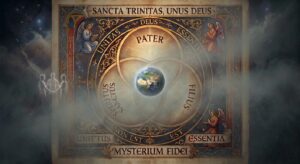
“The Greek term used to describe the eternal mutual indwelling of the persons of the Trinity is perichoresis (in Latin, circumincession). The word circulatio is also sometimes used as a way of metaphorically describing the unceasing circulation of the divine essence, such that each person is in the other two, while the others are in each one. At the risk of putting things in physical terms, perichoresis means that “all three persons occupy the same divine ‘space.’” From “Theological Primer – Perichoresis,” by Kevin DeYoung in The Gospel Coalition
The Wrong Dance
Although I do not know Greek, I have looked into the word “perichoresis” due to Richard Rohr’s mistranslation of it as a “dance” and applying it to the Trinity, forming a heretical view of the Trinity. Others, including Tim Keller, have made the same mistake in using the word as “dance.” But the word for “dance” and the one used by early church Fathers for the Trinity differ:
1. Choreography comes from choros (dance) [via choreia].
2. Perichoresis (the second part) comes from chōreō (to make room/contain).
The first word is related to dance and has led to a misunderstanding of “perichoresis.” Rohr took this misunderstanding to vast heights and applied it to the Trinity as a dance in his book, The The Divine Dance. Tim Keller (1950-2023) did this in his book The Reason for God. Others who did this were Jorgen Moltmann (1926-2024), Cornelius Plantinga, Jr. (b. 1946; Keller cites him), Pastor George Cladis (who falsely attributed the term to John of Damascus), and C. Baxter Kruger and Wm. Paul Young (both of whom are included in the CANA article on Universal Reconciliation). In many cases, this “dance” view incorporates a social Trinitarianism (see concerns under Section 2.2, “20th century Theologians and Social Theories”, in the Trinity entry in Stanford Encyclopedia of Philosophy).
This word has also led to other misunderstandings besides that of “dance.”
The Earlier Meaning
Perichoresis is a term with a history going back to the earlier centuries of Christianity. It was used to describe the mutual indwelling (some use the term “interpenetration”) of the three Persons of the Trinity to show that God is one yet is also three distinct (but not separate) persons (John 4.10-11; Col. 1.19).
Each person of the Trinity is fully God but the Father is not the Son, the Son is not the Holy Spirit, the Holy Spirit is not the Father. The Trinity is hard to grasp completely because God is uncreated and so nothing in creation can exactly mimic the Trinity. All analogies break down pretty quickly. Dr. Norman Geisler (d. 2019) used to say that the Trinity cannot be comprehended but it can be apprehended. It is taught in Scripture and has been confessed by Christians since the early church. It is one of the essentials of the faith that every Christian cult denies or redefines.
A helpful short article in The Gospel Coalition puts it this way:
“What perichoresis maintains is that you cannot have one person of the Trinity without having the other two, and you cannot have any person of the Trinity without having the fullness of God. The inter-communion of the persons is reciprocal, and their operations are inseparable.”
Panentheism
The reason it is important to understand this term is that some seem to take it to justify the view of panentheism, that God is in creation and creation is in God. After telling someone who was defending panentheism that God is not part of fallen creation, she said this to me (note her use of perichoresis):
“….everything exists in Christ. Christ came IN the flesh. He prayed we would know we are one with him. He is absolutely part of his fallen creation. He dwells in us. God created what is seen from what is unseen. Not out of nothing. Whoever denies Christ is come in the flesh is anti Christ. That word flesh is that which is fallen.
You don’t understand the mystery of Perichoresis. This is mutual inter penetration without loss of personhood. It is the oneness of the Trinity. All of creation is included in that circle of oneness.
Christ IS all and IN all. Nothing exists apart from him. He upholds all creation. That is absolutely Biblical. Separation mentality is the deception that is sin, ie missing the mark.”
Aside from many flawed arguments, this person is using the term “perichoresis” beyond what it means as though it includes creation. This is exactly what Richard Rohr does; he tells people that creation is the “4th person of the Trinity.”
“Some mystics who were on deep journeys of prayer took this message to its consistent conclusion: creation must then be seen as “the fourth person of the Blessed Trinity.” Once more, the divine dance isn’t a closed circle; we’re all invited in!” Richard Rohr, “The Fourth Person of the Trinity,” Sept. 21, 2016
Of course, Rohr believes that creation is the “body of God” (Richard Rohr, “Creation is the Body of God,” Nov. 11, 2015
Note the misuse not only of the term perichoresis, but she throws in the verse about Jesus coming in the flesh (to support her point about panentheism) and then quotes Colossians 3.11, that Christ is “all and in all.”
Response
Jesus came in the flesh, but the physical flesh itself is not sinful. Paul often uses the term “flesh” to refer to the sin nature and the commenter seems to think that the physical body and the sin nature are the same, or that the body somehow is sinful. The body is mortal as a result of sin, and although man sins with his body, Jesus never sinned (2 Cor. 5.21; Heb. 4.15, 7.26; 1 Peter 2.22; 1 John 3.5). Having a body does not mean Jesus was/is sinful or part of sin. Nor does the incarnation indicate that God indwells the material universe (Rohr teaches that Jesus was an “amalgam” of spirit and matter, which respresents that the Divine is present in all matter; and refers to Col. 3.11).
When read in context, Colossians is talking about the supremacy of Christ. Most Bible verses that are misused or misunderstood are understood correctly when put in context. I replied to her:
“Jesus is not part of fallen creation because there is no sin in Jesus. His human body suffered the effects of sin but was not sinful and Jesus retained his deity at the same time as being man. The original meaning of Perichoresis was a term some early Christians were using to explain how the Trinity is one, that God the Father, Jesus Christ, and the Holy Spirit are one but yet also distinct. But this has never included creation. Logically, it makes no sense to include creation because then God would not be God; he would be an impersonal organic energy like electricity if he were part of creation.
Yes, Christ upholds creation by his power but his power does not mean he is part of creation. He can uphold it without being part of it because he is God. You have swallowed a wrong view of perichoresis that was not the original view. That Christ is in all and in all is about his supremacy over creation, not that he is in creation.” – End of CANA remarks
The influence of Richard Rohr and supporters of panentheism goes much further than most realize.
More Panentheism
It is interesting that the misuse of Perichoresis seems to coincide with panentheism. Richard Rohr is openly panentheistic and Jorgen Moltmann was a panentheist as well. The description here of Moltmann’s views refers to perichoresis:
“Moltmann understands panentheism to involve both God in the world and the world in God. The relationship between God and the world is like the relationship among the members of the Trinity in that it involves relationships and communities (Molnar 1990, 674). Moltmann uses the concept of perichoresis to describe this relationship of mutual interpenetration. By using the concept of perichoresis, Moltmann moves away from a Hegelian understanding of the trinity as a dialectical development in history (Cooper 2006, 251). The relationship between God and the world develops because of God’s nature as love that seeks the other and the free response of the other.” From Stanford Encyclopedia of Philosophy
Like Rohr, Moltmann seems to take the meaning of perichoresis beyond to an application of panentheism. The article cites an excellent book I read and have recommended, Panentheism: The Other God of the Philosophers, by John Cooper.
Moltmann was a pioneer in the view of a Social Trinity (which seems to be Rohr’s view, and George Cadis has been critiqued for it), in which the Trinity functions like a community with three centers of being rather than one (Apologist William Lane Craig holds this view; see also here and here). Moltmann used Perichoresis as a way to avoid the Social Trinity appearing as polytheism (although I don’t think it helped). His panentheism and faulty view of the Trinity led to denials of God’s immutability and impassibility.
Being Careful with Words
Words can easily be misused and then can spread, just like the idea of Perichoresis as a dance spread rather insanely. In fact, in looking into this further for this post, I learned of even more theologians and others who took on these faulty views.
Misusing or misunderstanding a term seems to operate somewhat like rumors and urban myths, so it is not surprising that Scripture tells us to pay attention to our words.
“Set a guard, O Yahweh, over my mouth;
Keep watch over the door of my lips.” Ps. 141.3
“When there are many words, transgression is unavoidable,
But he who holds back his lips has insight.” Prov. 10.19 (also Matt. 12.36-37; Prov. 13.3, 12.18; Matt. 12.36-37; James 3.5-6)
Resources
The Gospel Coalition article by Kevin DeYoung on Perichoresis
This blog defends a mild and careful use of dance imagery for the Trinity to indicate the Trinity is not static (I don’t agree entirely but he makes some good points):
“To Dance, Or Not to Dance with the Trinity”
A critique of C. Baxter Kruger’s univeralist theology in Kruger’s book, The Shack Revisited, by Russell M. Grigg
“Why We Must Reject Social Trinitarianism,” by Craig A. Carter, in Credo Magazine, 7-15-21
Articles refuting aspects of William Lane Craig’s Social Trinitarianism:
“Eternally Begotten: Why William Lane Craig is Wrong on Nicaea,” by Andrew Moody
“Serious Errors in William Lane Craig’s postition on the Trinity and the Incarnation,” by Tony Arsenal
“William Lane Craig and Evangelicalism’s Deficit,” by Phillip Cary in First Things, 8-28-26
Apologist Sean McDowell does not challenge William Lane Craig’s view of God having “three centers of consciousness”); in this same video, Craig seems to express Partialism, that each person of the Trinity is “part of the Godhead.” In his articles, in his book, Philosophical Foundations for a Christian Worldview (co-authored with J. P. Moreland), and in this video clip, Craig states that the 3-headed dog, Cerebus, that guarded the gates of Hades, is a good analogy of the Trinity.
Willian Lane Craig also treads dangerous ground in his Christology. See blog on Craig’s faulty view regarding the affirmation that “Jesus is eternally begotten of the Father,” by Dr. Donald T. Williams, Professor Emeritus of The University of Toccoa Falls
Image from AI, Nano Banana 2