


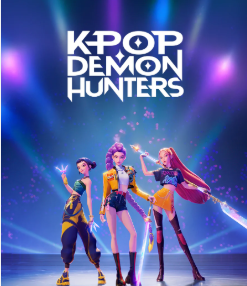
This article examines only some shamanistic elements of the movie “KPOP Demon Hunters” and not other areas such as trans/queer sexuality, violence, or materialism, all of which are themes that present problems and should be addressed by others who deal with those topics. I watched the movie on Netflix.
Shamanism and the Honmoon
Huntrix, a pop music band, is composed of three women, Rumi, Zoey, and Mira. They are part of a long line of “demon hunters” able to ward off demons with their music and voices by creating a shield around earth. This premise is seemingly built, at least in part, on an indigenous spirituality from Korea (which is perhaps connected to other Asian countries as well).
“Korean shamanism, also known as Musok (Korean: 무속; Hanja: 巫俗), is a religion from Korea. Scholars of religion classify it as a folk religion and sometimes regard it as one facet of a broader Korean vernacular religion distinct from Buddhism, Daoism, and Confucianism. There is no central authority in control of Musok, with much diversity of belief and practice evident among practitioners.
A polytheistic religion, Musok revolves around deities and ancestral spirits. Central to the tradition are ritual specialists, the majority of them female, called mudang (무당; 巫堂). In English they have sometimes been called “shamans“, although the accuracy of this term is debated among anthropologists. The mudang serve as mediators between paying clients and the supernatural world, employing divination to determine the cause of their clients’ misfortune. They also perform gut rituals, during which they offer food and drink to the gods and spirits or entertain them with storytelling, song, and dance. Gut may take place in a private home or in a guttang shrine, often located on a mountain.” From Wikipedia on Korean shamanism
The shield created by Huntrix that prevents demons from entering is called the Honmoon, and is presented in the very first minute or two of the movie:
“The Honmoon (혼문, hanja: 魂門 “spirit/soul gate”) is a magical protective layer that prevents Gwi-Ma and his demon forces from entering the human world. For generations, demon hunters have been tasked with maintaining it through the power of their songs. With enough power, the Honmoon can become golden and, as a result, be strong enough to seal away the demon world permanently. What it will do to those who are half-demon once given enough power is unknown.” From fan site
The connection of the singers and their fans also seals the power of this shield. When the Honmoon is golden, it is at its most powerful. In the movie, the demon hunters are able to seal the Honmoon in its rainbow state, which represents diversity and acceptance.
While the Honmoon itself is a fictional creation, its creation seems to be based on actual beliefs in mudang (shamans) as spirit mediums who use music, dance, and ritual to fight demons and guide spirits. A shaman traditionally is the mediator between the spirit world and the people of the tribe/village. Shamanism still operates around the world and in some countries it is very influential, such as Shintoism in Japan. Shamanism is animistic, believing that spirits inhabit nature and objects and must be appeased in order to gain fortune and avoid disaster.
“Animism then can be defined as ‘the belief that personal spiritual beings and impersonal spiritual forces have power over human affairs and that humans, consequently, must discover what beings and forces are impacting them in order to determine future action and, frequently, to manipulate their power.'” From article on animism by Gailyn Van Rheenen at missiology.com
The demon hunters-singers essentially are playing a simplified role of shamans, or mudangs (mudang is the Korean term).
“The mudang mediate between the human and supernatural worlds, doing so to decrease human suffering and ensure a more harmonious life. Specifically, they interact with gods and ancestral spirits by divining their presence and will, performing small rituals to placate them and gain their favor, and overseeing the gut rituals to feast and entertain them. The mudang‘s ability to perform their rituals successfully is deemed to come from myŏnggi (“divine energy”) bestowed upon them by the deities.” From Wikipedia
Since shamanism and animism still heavily influence many cultures (see this account of a kut, also, gut — a ritual done by a mudang, in South Korea , this article , or this 23 minute video), it is not surprising to see its ideas take shape in contemporary games, videos, books, and films. Pokémon, for example, is based on such ideas, as are the films “Avatar” (from James Cameron), “Avatar: The Last Airbender,” and “Frozen 2.”
Part Demon
One of major themes of the film is that one of the demon hunters, Rumi, is part-demon, since her father was a demon, although her mother was a demon hunter. She has scars on her body indicating that she has demon heritage and she wears clothes to cover them. (Rumi is viewed by the trans and queer community as a symbol for a trans/gay person who has to hide who she really is; multiple articles and videos propose the film as a gender or queer allegory, such as this one in Out Magazine and this video).
Demons who serve Gwi-Ma, the head demon, propose to enter the world disguised as a boy band, the Saja Boys, in order to destroy the demon hunters. The demon singer in this band, Jinu, has a meeting with Rumi, who initially tries to kill him but is unable to. Meanwhile, the Huntrix fans are disappearing because the demons feed off the souls of the fans. However, this seeming tragedy is almost downplayed because the main focus is on the effect it has on the fame of the demon hunters.
Jinu shares his story about his early years in poverty, and how the main demon Gwi-Ma made him a good singer and gave him a life of luxury. For this, Jinu became Gwi-Ma’s slave and taken to hell. Jinu’s family became worse off than before and Jinu now feels shame for his actions. The scars on his body remind him of this just as Rumi feels shame about her scars.
So some demons, like Jinu, are portrayed as victims. Although he did bad things, at heart he is supposedly good and does not want to serve Gwi-Ma. This minimizing of evil is typical of all views outside of Christianity. The focus is on the shame both Rumi and Juni feel, rather than on any moral standard.
When Rumi accepts her scars and status as part demon, she is empowered and able to sing so that a failing Honmoon is repaired and the demons ousted.
Why I Do Not Recommend This Movie
The movie is clever and entertaining, with a lot of humor that will resonate with young people. However, I do not recommend this movie for anyone for many reasons. The minimizing of evil, the lack of any moral standards, the implied shamanistic themes of power from the demon hunters, the message that one must accept one’s self in order to be empowered, the idea that people can overcome evil by their own power or by a supernatural power, and the counterfeit love and peace idea presented by the Honmoon are just some of the reasons I advise against this film.
Discussing the Film
Since it so popular – and the songs have become hits – it is good to know about it if your child or teen has seen it. Use the film as a way to discuss its worldview in light of Scripture. You could ask some of these questions or bring up these topics to start a discussion:
- What is it about this movie that you like besides the music?
- What do you think of Rumi being a half-demon? Is it good that she becomes okay with this? Why or why not?
- What do you think of the Honmoon? Do people have power to create something like that?
- Does God want us to accept ourselves the way we are naturally and stay that way?
- What does Rumi do to deal with her shame? Is it the answer?
- How do people in the movie know if they have done something wrong?
- What solution to evil does the movie give us? What does God tell us the solution to evil is?
- What do Rumi, Zoey, and Mira have to look forward to after the demons are gone?
- Name some differences that you can think of between the ideas in this film and what we learn about God and Jesus in the Bible — about who we are, what love really is, what our future is, who actually has power over creation, etc.?
You may come up with your own questions or topics but you need to watch the movie to do that.
Some may think I saw too much in this film but the ideas of shamanism were apparent to me in the first few minutes. After thinking it over and reading about Korean shamanistic practices, I believe the evidence for it is there.
I think there will be only more films like this one, probably with darker themes, although false ideas of love and harmony will prevail to make the messages appear good.
See below for related material in CANA articles:
Pokémon: Of Animism and Occultism
They Have Eyes But Cannot See: Christianity vs. Animism
Excellent article on animism
“Defining an Animistic Worldview” by Gailyn Van Rheenen
This article at https://shorturl.at/nT9W9