


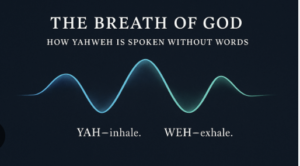
After I was initially asked about the idea that speaking the name of “Yahweh” is the same as breathing, and also sometimes equated with the breath of God, I looked into it and wrote this article on it. The topic has since come up again when I was informed about a video made by Richard Rohr promoting the Yahweh-breathing idea. Although I discuss Rohr in the original article, I decided another article with comments on Rohr’s video and further thoughts on the topic was needed. The Yahweh breath/breathing idea is still making the rounds, if not more so. (See Addendum at end for further information on the name “Yahweh”).
Rohr’s Video
In this six-minute video clip, Richar Rohr claims he heard a rabbi speak on the third commandment, “You shall not take the Lord’s name in vain,” and that Jews have interpreted this as a command to not speak the name of God at all. Rohr appears fascinated with this interpretation. It is true that there is a Jewish tradition for not saying God’s name; however, there is no biblical basis for it, and furthermore, that is not what this commandment means.
Rohr tries to make the “intellect” an enemy of knowing God and states that when one is breathing YHWH, it “has nothing to do with thinking.” But Jesus said to love God with “all your heart, with all your soul, and with all your mind” (Matt. 22:37, a reference to Deut. 6:5), which means to love God with the whole person. As I have written in many articles, we cannot separate our will, mind, soul, and feelings. The “heart” in Scripture almost always refers to the whole person.
It is also true that mystics like Rohr portray the mind and thinking as inferior to feelings, inner voices or promptings, and what they would consider to be spiritual. Scripture actually teaches to use reason and the mind, and never speaks against thinking.
In the video, Rohr asserts that when a baby is born, he or she is saying God’s name, and when we die, one does not need to say a prayer because we will be praying when we take our last breath. So everyone is saying God’s name all the time when they breathe. This actually downgrades God’s name and cheapens it.
Panentheism
When I was first asked about this topic, I traced the idea to a blog referencing an article by Sandra Thurman Caporale. I wrote my article on that, and included Rohr’s ideas on it from his blog. Whether Caporale got it from Rohr or not, I do not know, although AI states Caporale was “inspired” by Rohr. But the fact that Rohr promotes this is not surprising since it fits into his mystical belief system.
Rohr loves this idea because to him that means that breath and God’s name are one and the same, which fits into his panentheism (God is in all; all is in God). In fact, he thinks that the very particles of our body are divine, that the divine intersects and inhabits matter. Rohr’s panentheism is part of his Perennial Wisdom beliefs; he is an open adherent of Perennial Wisdom.
Panentheism erases the distinction between God and creation. Although not as obvious as pantheism (All is God and God is all; God identified with creation), it is just as much a deadly unbiblical doctrine. In fact, it is more deceptive than pantheism since it posits a God who is transcendent as well as being in creation.
Who God Is Matters
The fact that it is a known tradition that Jews would not say God’s name does not mean it is wrong to say God’s name. When Moses asked who he should tell the people is sending him, God gives him a name, meaning that Moses should convey this information to the people. Was Moses supposed to say, “God gave me a name, but I can’t tell you what it is”?
Moreover, the meaning of the word ‘Yahweh,’ “I am that I am,” is more a description than a proper name. God is revealing who he is with this name, not just giving a name. What gets obscured in these mystical ideas is the import of the meaning of the name and who God is.
Mysticism always muddies and sometimes distorts the truth, and often confuses or twists it.
God is living and eternal – “I am that I am” – he always is. He has no needs and no dependence on anything – he is self-sufficient and self-existent. That is called the aseity of God. This is a crucial aspect of God’s character, but those promoting the Yahweh-breathing idea are missing out on it.
Idolatry
Focusing on the breath is idolatry because it is not a focus on God. It also becomes a focus on self, and many actually believe they are somehow connecting with God this way, or that God’s breath is actually in them. (See CANA article on God’s breath and other false breath notions).
This idea also gives more popularity and credibility to breath prayers. Breath prayers are a mystical practice, not a biblical one. It is amazing that so many would practice breath prayers when there is not a shred of support for it in Scripture.
The Scripture that comes up again and again as a claimed basis for breath prayers is First Thessalonians 5:16-18:
“Rejoice always; pray without ceasing; in everything give thanks, for this is God’s will for you in Christ Jesus.”
Does it really make sense that one should pray constantly? This is clearly about an attitude and a pattern of prayer. To “pray without ceasing” is to develop a prayerful attitude such that one seeks God in prayer in all situations. What makes more sense – to pray constantly in a robotic way, or to pray whenever and wherever one may want to seek the Lord?
In other words, do you take time to pray when you are upset, angry, lonely, jealous, depressed, impatient, grateful, etc. no matter where you are or what you may be doing? If one prays, however briefly, in all those situations, then one is praying “without ceasing” because one constantly prays when faced with the opportunity to do so. As this article states, “you cannot always be in prayer” but “you can always be prayerful.”
If it is a built-in habit to pray like this, one prays as a learned reaction. One does not need to be in a church or at home, or with other Christians to pray. It becomes a habit to pray, even silently if necessary. Pray for the person in front of you at the grocery store who is upset; pray for the neighbor who just told you she has cancer; pray for help if you are being rude to somebody and for forgiveness if you have realized you were rude; pray as you hear news of a family member’s divorce — there are countess opportunities to pray.
Thoughtful prayer is what Scripture teaches; not mindless repetition or techniques like breath prayers. Breath prayers are also pagan because they are manmade techniques to access, connect with, or gain something from God.
To take “pray without ceasing” literally is to distort and redefine the meaning. What is called for is perseverance in prayer in situations in which prayer is called for or is needed. This is the more difficult and deeper duty of the believer than meaningless techniques akin to New Age practices.
Commentaries
The thoughts expressed here were confirmed by commentaries at Bible Hub:
“(1) That we are to be regular and constant in the observance of the stated seasons of prayer. We are to observe the duty of prayer in the closet, in the family, and in the assembly convened to call on the name of the Lord. We are not to allow this duty to be interrupted or intermitted by any trifling cause. […..]
(2) we are to maintain an uninterrupted and constant spirit of prayer. We are to be in such a frame of mind as to be ready to pray publicly if requested; and when alone, to improve any moment of leisure which we may have when we feel ourselves strongly inclined to pray.” – From Barnes
“Without ceasing; not as the Euchites and Messalians of old, who hence thought no other duties were required, but always praying; but by the word in the text, is either meant a praying without fainting, as in the parable, Luke 18:1, and which the apostle calls a perseverance in prayer, Ephesians 6:18 Colossians 4:2; proskartereite, or praying with strength, as the Greek word there imports, and so not to faint; so Romans 12:12. Or a praying in every thing, as Philippians 4:6: In every thing let your requests be made known, & c. Or, in every season, as Ephesians 6:18; to take hold of the seasons of prayer. Or, in all seasons and times, whether good or bad, yet still to pray.” – From Matthew Poole
Gill writes that praying all the time would interfere with other things the Lord has called Christians to, as well as interfering with rest, eating, and sleep.
Breathing is not to be idolized or made into a mystical practice. Breathing is a physical activity to keep oxygen going to the lungs and stay alive. It is the way God made humans and other breathing creatures.
All prayer in scripture is verbal and uses the mind, not a technique. Jesus gave the disciples a pattern for prayer in what is called “the Lord’s Prayer” or the “Our Father.” This is a pattern, not a technique.
Other Resources
Three Reasons Yahweh is not the Breath of God, John Newton
The Name and Sound of Breath, Dr. Stan Helton
Video on God’s name and breathing
Addendum: The Name Yahweh
Dr. Thomas Howe, who has taught Greek and Hebrew at Southern Evangelical Seminary, had some comments on this video. He points out that the rabbi said that one is not to speak the divine name, but then he talks about how one should speak it. Dr. Howe continues:
“Ancient Hebrew certainly had vowel sounds, since not to have vowel sounds one cannot speak. In the ancient language, there were no marks that represented the vowel sounds. Syriac and Aramaic were the same, written consonants without vowel marks. The points that are now used in modern Hebrew Bibles were developed by the Masoretes beginning around 600 AD. The vowel sounds for pronouncing the divine name have been lost precisely because the divine name was never written with vowel points. This was to prevent pronunciation. In the modern Hebrew Bibles, the tetragrammaton is pointed differently in different passages. Consequently, there are conflicting views even today about how the name should be pronounced.
In many existing manuscripts the divine name was written in Paleo Hebrew script even though the surrounding text was written in the Aramaic square script יהוה that is used in the modern Hebrew Bibles. This was to alert the reader not to pronounce the name. So, when reading, one would not pronounce the divine name, but substitute the word ‘Adon’ (a long o sound) or Adonay. The Shema would be read, “Hear Israel, Adonay our God, Adonay is one,” rather than “Hear Israel, YHWH our God, YHWH is one.”
Short link: https://tinyurl.com/3vbwehes