


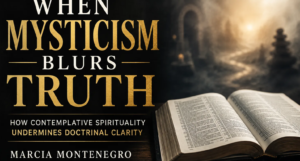
Article, “When Mysticism Blurs Truth: How Contemplative Spirituality Undermines Doctrinal Clarity”, by Marcia Montenegro is in the Summer 2026 Issue of Theology for Life, published by Servants of Grace.
“The purpose of this article is to demonstrate how contemplative spirituality undermines doctrinal clarity based on God’s word by examining current trends in Contemplative practices. Biblical responses are given as well.
Contemplative Spirituality is Mysticism
Contemplative Spirituality refers to a movement in the church based on mystical practices. Contemplative Spirituality does not derive from Scripture, but rather is rooted in practices from sixth century monasticism; alleged texts from the “Desert Fathers;” the writings of mystics such as Teresa of Avila, John of the Cross, Brother Lawrence, and others; the anonymous fourteenth century work, The Cloud of Unknowing; Eastern religious meditation methods; and recent teachings from those who have popularized these practices.
Contemplative Spirituality references Scripture and claims to be biblical; however, since it is rooted in mysticism, it is crucial to explain mysticism and why it is not compatible with Scripture.
How Mysticism Blurs Sound Doctrine
Mysticism has been defined as an unmediated contact with the Divine (or whatever the sacred source or being might be called). Mysticism is experience oriented and does not recognize any spiritual authority, including God’s word. Its methods focus on going inward. Mysticism does not seek a doctrinal foundation, nor does it value reason, logic, or analysis. Instead, it is subjective, ineffable, and esoteric.
Subjective
Subjective knowledge is gained primarily through an inner experience. It does not arise through reasoning or via normal introspection, so it is not based on objective evidence or truth. Such knowledge is not verifiable; as a result, its assertions cannot be evaluated or tested by any truth standards. This protects Contemplative teachings from criticism, since the defense is that one must have the experiences to really understand it.
This mystical knowledge or experience is viewed as superior to principles based on facts, reasoning, or logic, including God’s word.
Ineffable
Ineffable refers to knowledge or experience that cannot be communicated in words. Words are deemed inadequate to express the mystical experience or knowledge; therefore, the mystical is valued over what can be articulated.
Using words to assess such experiences is viewed as inadequate or even hostile to the Contemplative inward journeys. The claim that one has grown closer to God through mystical practices appears unassailable for those in Contemplative Spirituality, due primarily to these inner experiences.
Esoteric
Another trait of mysticism is that it is esoteric. That is, it is secretive, unable to be communicated with the mind or words, and must be sought inwardly through certain practices. As this Christian article, which supports such ideas, states:
“Esotericism, by contrast, offers a more structured and selective path. It involves the study of mystical texts, sacred correspondences, ritual practice, and symbolic systems. The seeker often progresses through initiatory grades, each unveiling deeper layers of insight. Esotericism asks, ‘What is the hidden order behind the visible world? And how can I align with it?’”
In this view, what is perceived with the mind and senses is false, shallow, or insufficient. This includes knowledge about God from Scripture…..” Continue reading here…
Short link for article to Theology for Life site: https://tinyurl.com/mr3pc7am