


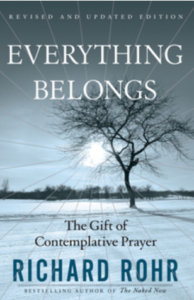
Most people reading Richard Rohr’s book, Everything Belongs: The Gift of Contemplative Prayer, would not know from the book itself that Rohr is advocating the spirituality of Perennial Wisdom, which includes beliefs in Panentheism and Nondualism. These words are absent in the book.
Unless the reader looks at “About the Author” at the back of the book,* the assumption from most would likely be that this is a Christian book. The “About the Author” page, however, states openly that Richard Rohr
“is a globally recognized teacher bearing witness to the universal awakening within Christian mysticism and the Perennial Tradition.”
The Title
The title and subtitle actually contain the seed of Rohr’s Perennial Wisdom, “Everything Belongs: The Gift of Contemplative Prayer,” because in Rohr’s view, the One (the Perennial god) who is truth, is nondual and contains all of creation; and Contemplative Prayer is the gift because it allows one to see this alleged vital truth.
Rohr writes that when one is finally “awakened,” one sees that
“opposites collide and unite, and everything belongs. In mature religion, the secular becomes sacred” (159).
He cites the French Roman Catholic paleontologist, Teilhard de Chardin (1881-1955), that there is only one world and it is supernatural. This is because Teilhard saw creation contained in God evolving toward one spiritual unity. As theologian Andrew Del Rossi writes:
“Teilhard experienced and understood evolution as the increase in awareness of the Divine within the world. Teilhard’s faith is rooted in his belief that evolution is moving to a point of wholeness in God. Thus, the human person is seen as an organism capable of growing into a fuller awareness of itself in communion with the universe.” (Teilhard’s Catholicity: An Evolution in Consciousness,” from MDPI article by Andrew Del Rossi
Teilhard’s view profoundly influenced Rohr’s teaching that a power called the Universal Christ is pulling all creation toward perfection, what Teilhard called the Omega Point (Teilhard usually used the term “Cosmic Christ,” which Rohr initially used before adopting the “Universal Christ,” a term also used by Teilhard).
There are two primary features of this belief (Teilhard was not viewed as a Perennialist since he did not believe all religions are rooted in or lead to the same one truth). The two main features of Rohr’s Perennial Wisdom, Panentheism and Nondualism, dominate the themes of this book without ever being mentioned.
Panentheism and Nondualism
The Panentheism and nondualism are subtle since Rohr does not use either word (nor does he use the term “Perennial Wisdom”). He makes references to an “ultimate Oneness” (151), and avers that God is “found in all things” (177) and “is hiding in physical reality” (117, 118). Reality is “divided” and it is religion’s task to put them back together; mystics are able to do this, asserts Rohr (136).
Many things Rohr writes sound good and so the reader is pulled along Rohr’s path right into the ditches. Rohr believes that there can be a “convergence of the Eastern and Western ways of knowing in faith” and he mistakenly calls this “the mind of Christ,” which is also the “big mind” (124).
The “big mind” idea is one Rohr likely got from Buddhism; Rohr refers to Buddhist stories and proverbs throughout the book. In Buddhism, there is only one reality, formlessness; all else, which includes all of creation, is form, and has no substantive reality. One’s self does not really exist.
Becoming aware of this reality is aligning with Buddha Mind or Buddha nature (also Big Sky mind). It is allegedly pure awareness, a state of enlightenment.
The Ego, Christself, and Thinking
Rohr contrasts the “big mind” with “small mind theology” and “analytic theology” of the “West,” as opposed to the “paradox and mystery” of the Eastern Orthodox Church. His chapter on “Ego and Soul” discusses the “small I” versus the “true I,” the latter being equated with the “true self” and the “soul” (72). The ego is equated with the “false self” (82).
Waxing ardently on this theme, Rohr quotes his favorite mystic, Julian of Norwich (1342-1416); New Thought teacher, Marianne Williamson; Zen teachers; and Jesus. Although I think many Christians might find much of this book rather puzzling, this chapter might be the most convoluted.
After many words, Rohr gets to his point:
“Thinking creates the ego self…the insecure self,” while “contemplation recognizes the Godself, the Christself of abundance and security” (78).
Thinking per the Contemplatives is what holds one back from realizing the truth, which can be called the mystery, ultimate reality, the Absolute, the Oneness, the all-in-God and God-in-all, Living Wisdom, or whatever term might be used. Rohr writes that he has not known anyone “in their head” who is “at peace,” and that
“Prayer must lead us beyond mind, words, and ideas to a more spacious place where God has a chance to get in” (149).
Silence in prayer, asserts Rohr, is superior to words and leads one to the “knowledge that ‘it is good’ as in Genesis 1” (149). Silence here means not using words at all in prayer, but rather being in a contemplative state of no-thinking.
“When we sit in meditation, we become the vast sky allowing our thoughts to rise and fall and not hindering them in their rising and falling or chasing them across the sky” (“Big Sky Mind, A Dharma Talk by Christopher Kayuyo Sensei in “Everyday Nembutsu”).
I was taught to practice Zen Buddhist meditation this way when I was in the New Age and involved in Buddhism, by seeing my mind as a sky and to let thoughts drift across the sky like clouds (I was taught another technique for Tibetan Buddhist meditation prior to my involvement in Zen which also seeks to reach a no-thinking mind). The state achieved with this method is the same as the one reached doing Contemplative practices. It is a state of no-thinking when critical thinking skills are suspended.
Contemplative teachers without fail make a false dichotomy between the mind and heart (or spirit) and between words and silence. They subtly, or sometimes overtly, demean words (including Bible reading/study) and the thinking mind. However, Scripture actually teaches to use reason and the mind, and never denigrates thinking, only the wrong objects of thinking.
“Godself” and “Christself” are terms that refer to the Perennial view that one’s True Self in God as part of God, along with the “universal Christ,” who is also an archetype (Rohr does not state that Christ is an archetype in this book but he does elsewhere, such as here and here).
David G. Benner, published as a Christian author, asserts in his popular book, The Gift of Being Yourself, that “my deepest self is Christ-in-me” and that “actualizing the Christ who is in us” is a “journey toward union with God” (taken from CANA article on Benner’s book ). Benner, a “Master Teacher” at Rohr’s Living School, is an ardent adherent of Perennial Wisdom who runs a Perennial Wisdom school in Canada, the Cascadia Living Wisdom School. Like Rohr, Benner also believes Jesus is an archetype.
Recognizing these terms such as “Godself” and “Christself,” which might be misunderstood as referring to the “new self” in Christ, is crucial so that one can avoid the Perennial language deceptions. The word “Christ” is all over the writings of Rohr and Benner, who consider themselves followers of Perennial Wisdom “in the Christian tradition.”
Perennial Wisdom devotees generally believe that one should seek this perennial truth via one of the world’s major religions since all religions allegedly stem from one original pure religion. Although they willingly join together for prayer, meditation, or forums, they do not believe in erasing religious boundaries because this would deprive people of their religious traditions which can lead to Perennial Wisdom.
The Door to Enlightenment
The way to see this nondual reality, which is the true reality in Rohr’s beliefs, is through Contemplative practices which go beyond or set aside the thinking mind. Rohr writes:
“The private self is clearly an illusion largely created by thinking” (78).
This is a sentence any Buddhist, many Hindus, and many New Agers would love, but Rohr is expressing Perennial Wisdom, which can sound like those other beliefs but yet differs from them. The True Self is the self that has come from God, has always been with God, has never separated from God, and will go back to God. He refers to God (without saying it is God) using terms such as “the Presence” (61) and “the Absolute” (87), terms common to Perennial Wisdom.
Rohr starts with the idea of a small, false self and builds to the True Self to say that once contemplative practices get the false self out of the way (82), one can see the reality that God is in everyone and in everything. God “can absorb the contraries” (88). Mystics see this, asserts Rohr, and using contemplative practices to break through to “enlightenment” (82) will get you there:
“All spiritual disciplines have one purpose: to get rid of illusions so we can be present” (31).
“All spiritual disciplines exist to help you trust this personal experience of yourself, which is, not surprisingly, also an experience of God” (88).
This is “one great truth that you know in a moment,” avers Rohr, but “we must return to it in daily prayer” (82). The prayer Rohr speaks of is a type of contemplative practice referred to here and throughout the book; it is not prayer modeled in Scripture.
Response
Panentheism makes God part of a fallen creation but since God is uncreated and perfectly righteous, it is impossible for God to be part of his creation. God’s omnipresence means nothing can contain God and God cannot be limited to a place or places. God is present everywhere but he is distinct from every part of creation.
God does not absorb “all contraries” but rather, “God is Light, and in Him there is no darkness at all” (1 John 1:5b). Rohr speaks of God as love (which is true) but the god of Perennial Wisdom has no attributes of righteousness because righteousness is the attribute of a personal God, and the Perennial god is more of a principle. The traits of the true living God of Scripture and of gods in various beliefs systems are viewed as lower-level manifestations of the Perennial god, who resembles more the impersonal Tao of Taoism or the Brahman of Hinduism.
Rohr has argued that the incarnation shows that the divine and the profane are joined, and therefore, everything is divine. He ignores that the hypostatic union, that Jesus was fully God and fully man, applies only to Christ. There is no other example of such a union and there can’t be since it applies to the eternal unique Son of God.
Moreover, Rohr has another Jesus. Rohr makes a distinction between the historical Jesus and the so-called Universal Christ, because Rohr teaches that the Universal Christ is greater than Jesus. Rohr writes about this on his blog:
“…it seems we so fell in love with this personal interface in Jesus that we forgot about the Eternal Christ, the Body of God, which is all of creation, which is really the First Incarnation. Jesus and Christ are not exactly the same. In the early Christian era, a few Eastern Fathers (such as Origen of Alexandria and Maximus the Confessor) noticed that the Christ was clearly older, larger, and different than Jesus himself. They mystically saw that Jesus is the union of human and divine in space and time; and Christ is the eternal union of matter and Spirit from the beginning of time.
Jesus willingly died—and Christ arose—yes, still Jesus, but now including and revealing everything else in its full purpose and glory.
Jesus is the visible map. The entire sweep of the meaning of the Anointed One, the Christ, includes us and all of creation since the beginning of time.” From Rohr’s blog, 9 April 2023 (the bolded section is italicized in the original
Rohr teaches that the first incarnation of Christ was creation itself, and that Jesus is the second incarnation of this Universal Christ.
“Franciscan philosopher and theologian John Duns Scotus (1265/66–1308) taught that Christ was the very “first idea” in the mind of God. In other words, God wanted to manifest the Godself externally, so an eternal love affair could begin between matter and God who is spirit. This divine love affair, eventually called “the Christ,” has been unfolding and manifesting for about 14 billion years now. Jesus came as its personification a mere 2000 years ago, I guess when human consciousness was mature enough for a face-to-face encounter.” From “Rohr’s blog, “The Christ is Bigger Than Christianity,” 26 March 2017.
Rohr has other heresies regarding Jesus, including that Jesus did not die for sins and there is no second coming of Jesus.
Rohr’s Gospel
If the goal is enlightenment, then what about salvation? Rohr contends that
“We aren’t born again; we are born again and again and again” (52).
Rohr asserts this because he thinks that once on this journey to the nonduality of truth, one must continue the practices that are leading one to a fuller understanding of this truth. There is no exclusivity because
“we are created in the image of God, we have come forth from God, and we will return to God” (96).
Rohr leans heavily on the visions of mystic Julian of Norwich (1342/43 to 1416?) who claimed 16 “spiritual visions” (called “Showings”), discussed in her Revelations of Divine Love . Receiving a vision of a Servant (whom Julian realized was Adam) and writing about Adam’s fall,
“Julian is eager to find out whether the Lord will assign his Servant any blame, but he does not. The Servant fell only due to his great desire, and so he is as inwardly good as when he stood ready and waiting on the Lord.”
(Rohr does not reference this particular vision but it is important for context).
According to Julian, Jesus told her that sin would not be a shame for humans “but a glory” and that “the mark of sin shall be turned to honor” (chapter 38, Showings 13 of Revelations of Divine Love as cited by Rohr on page 129).
Rohr misinterprets and misuses the account of Jesus and the woman at the well in John chapter 4, and states that God’s love “is always unconditional and usually unilateral” (129). He writes that Jesus said “don’t be afraid” (he gives no citation or context) and was telling us that
“It is radically okay. You can trust yourself because God trusts you” (129).
The idea that God trusts men is similar to assertions from Rob Bell (Velvet Elvis, pp. 133-34 cited here) and John Mark Comer, both of whom have written that Jesus has faith or believes in you (see section “Jesus Believes in You” in CANA article on Comer’s book).
The Bible tells us the opposite:
But Jesus, on His part, was not entrusting Himself to them, for He knew all men, and because He did not need anyone to testify concerning man, for He Himself knew what was in man.” John 2:24-26
The above quote is not a compliment to humans. Jesus said to believe in him for eternal life. The Trinitarian God who knows and created all things has no need to believe in anyone or anything.
Rohr writes of God’s forgiveness as unconditional and that those who know God best, the mystics and the hermits, “always meet a lover, not a dictator” (131). God doesn’t look at our “faults,” claims Rohr, and quotes Julian that God will judge us “by our true inner nature” and “not assign any blame” to man (163, 166). “God is a lover who receives and forgives everything,” writes Rohr (131).
Response
Jesus was inclusive in his appeal to people to recognize him as the Messiah but exclusive about who would be forgiven and be with God for eternity, which could only come from believing Jesus as the Messiah, fulfilling over 300 Old Testament prophecies.
The death of Jesus on the cross to pay the penalty for sin shows that forgiveness costs something and is not universal; otherwise, why would Jesus have to die? There are too many passages to include here, but the whole of the Bible, starting in the Hebrew Scriptures, demonstrates the necessity for a Savior so that those who believe can have eternal life with God.
But since Rohr has a false Jesus, it is not surprising he has a false gospel.
The book shows where Rohr’s beliefs have led him and how contrary they are to God’s word and to the historic Christian faith. Because Contemplative practices are infiltrating the evangelical church, seemingly without pause, and because of Rohr’s influence on the practices and ideas of Contemplative teachers in the church, it is critical to know Rohr’s beliefs. (This is aside from the damage already done in the church by the Enneagram, largely due to Enneagram teachings from Rohr’s allies such as Ian Cron and Suzanne Stabile as well as other Enneagram teachers).
For a mature Christian who wants to understand the implications of Rohr’s Perennial Philosophy and its mysticism and contemplative practices, this book would show that. It is not, however, a book to recommend to anyone else.
*(Note: Topics discussed in this article are difficult to categorize or separate since they converge in the book, and Rohr returns to them throughout the book. Quotes and references are from the revised and updated ed., The Crossroad Publishing Company, 2019.).
Short link: https://tinyurl.com/2r322ujx